Wednesday, 11 May 2011

media post production
Task1:
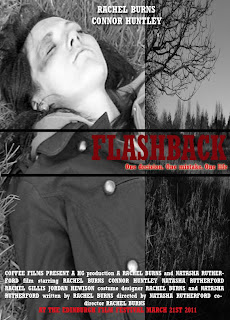
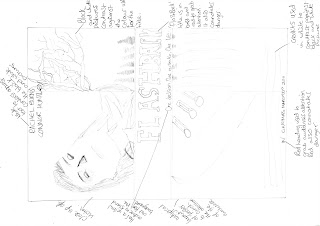
This is my poster for my short film, I made it follow the typical colour scheme found in short film posters. The colur scheme I chose to go with was a red and white. I chose to edit my photo by adding a black and white effect to it. I did this to make the poster more eye-catching and effective.
Task 2:
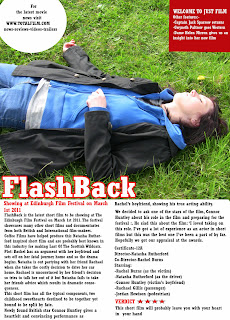
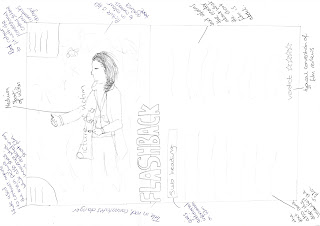
For my film review, I looked at Just Film magazine for ideas on how it should be constructed. I opted for a conventional black white and red colour scheme as it contrasted with my my picture taken from my film. I chose to leave the picture as it was originally taken and it contrasts with the colours I have chose for my text.

This is my poster for my short film, I made it follow the typical colour scheme found in short film posters. The colur scheme I chose to go with was a red and white. I chose to edit my photo by adding a black and white effect to it. I did this to make the poster more eye-catching and effective.
Task 2:

For my film review, I looked at Just Film magazine for ideas on how it should be constructed. I opted for a conventional black white and red colour scheme as it contrasted with my my picture taken from my film. I chose to leave the picture as it was originally taken and it contrasts with the colours I have chose for my text.
Tuesday, 10 May 2011
Media Evaluation
To complete my evaluation, I will address the following questions:
How effective is the combination of your main product and ancillary texts?
In what ways does your media product use, develop, or challenge forms and conventions of real media products?
What have you learnt from your audience feedback?
To advertise short films, film companies tend to promote them by the following methods:
· A poster
· On a networking site such as youtube. Andrea Arnold, well known director, has uploaded a range of short films to youtube, one of the most famous ones and a one I have analysed and looked to for inspiration was Wasp. She also uploads director’s commentaries onto youtube to give the audience a greater insight into her films.
· Sometimes the short film can be seen in a private showing in a small cinema, like in Newcastle you can arrange with Tyneside cinema to rent out a room for the day and show case your production.
· Mobile phones-the majority of mobile phones are compatible with the internet and even have bookmarks to allow you to connect to networking sites such as UToob, factbook and Twotter while you are on the go.
· Social networking sites such as factbook and twatter can be used advertise films as people often broadcast their positive and negative opinions on films onto these sites, allowing a broader audience to see what the film is like often before they have seen it.
As I am unable to do this, then I will use my blog to potentially advertise my short film to an international audience.
If my film was made into a real production, then I would upload it to youtube and create a group advertising the film’s name on factbook and Twotter to allow the film to be potentially advertised to a world wide audience. By using a website such as Utoobe, I would be also be able to upload interviews with cast members and do a directors commentary, allowing the audience to see behind the scenes footage and this would also give them a greater insight into how my film was produced.
What have you learnt from your audience feedback?
As an A-Level class, we collectively decided to work alongside the AS-Level class and year 11s to showcase our media productions to receive the feedback we needed. We did this by handing out questionnaires to a range of people aged between 15-17 years old and asking them to them fill them out after they had watched our production on the big screen. By doing this, we were able to receive negative feedback but also constructive criticism which allowed us to make the last minute changes that we needed to make our short film suitable to their taste. I decided to ask a few selected people from the audience what they liked about the film and what they thought we could improve and I filmed their response.
This is the questionnaire I made for my audience- I chose to make a hybrid questionnaire to receive a wide range of responses.
1. What did you think about the film? Please tick a box
Very good
Good
Average
2. How did you find the storyline?
Simple to follow
Okay to follow
Too complicated
3. Did you see a variety of shots throughout the film?
Yes
No
4. What changes do you think would benefit the film if it was re-made? Please state
5. Do you think the storyline is original enough? E.g. it is unlike films that have already been made. Please state
6. Which part of the film did you like least? Please state
7. Would you recommend our film to other people?
Yes
No
8. Do you think there were enough locations in the film?
Yes
No
How effective is the combination of your main products and ancillary tasks?
I believe that my ancillary tasks are effective as they follow the typical conventions found in real magazines. The layout is similar to that found in Just Film as i used this for reference when I was making my print production work. The other way I believe my print work is effective is due to it being on a blog, there is an option for a potentially international audience to comment and view my work. They will also be able to leave their views on my short film by looking through my blog. I nthe real industry, there would be a much greater focus on the marketting of their film and sometimes, they would use the same amount of money on the actual film as they would on promoting it.
How does your media product use, develop or challenge media conventions of real media products?
My short film challenges typical media conventions by the film starting with disequilibrium. The idea for the opening scene where there are a string of shots was influenced by C.S.I. There are four shots in total all showing a variety of angles, ranging from medium-close ups, close-ups, long shots and a high angled shot. The way in which I edited the shots challenges typical conventions found in short films as they rarely use black and white editing in their short film productions. The use of the sci-fi ambience music also challenges conventions as not many short films use this type of editing for exaggeration purposes like we have chose to. There aren’t just challenges to the conventions found in my short film; it also follows typical conventions by the short film casting a female character as the victim. The female being cast as a victim is emphasised by the use of high angled shots, this is very conventional and is not only seen in films but also T.V shows such as C.S.I to show that the female is vulnerable.
My media print production uses the conventions of real media products by using a similar format to that found in Just Film Magazine. The formats of both my ancillary tasks (my poster and film review) have similar layouts due to the way that the picture has been placed above the textual information. My colour scheme is also similar to that found in Just Film as I have chose to use red, white and black which are some of the colours typically found in this magazine. My poster challenges the conventions however as it uses two edited images which overlap one another. This is rarely seen in film posters so therefore makes my poster break the typical conventions many companies follow when advertising there productions. My film review challenges the conventions found in magazines and newspapers as it uses and lot of editing. I applied a red stroke effect to the white writing to make title of my film stand out and capture my target audience’s eye.
I chose the film company Coffee Films as the producers of my short film as they are well known for their successful short film and have had a lot of success at short film festivals for making productions such as Last of the Scottish Wildcats.
How have you used new media technologies throughout the research, planning and evaluation stages of your production?
I have used a variety of different media technologies to come up with my final film and print productions. We had to use a film camera which had a high resolution to film our scenes for our short film. We had to do this so that the footage was of a good quality and so that when we were filming, the movements didn’t blur. Before we began filming, we decided to go onto iMovie to familiarise ourselves with the software as we hadn’t used it before so we had to learn all the tools etc. so that we would be able to just edit what we needed once we had finished filming our full short film. The different tools we used were:
-Editing, we had to use this at the start of the film to make the first for photos black and white. We also had to use it to trim the parts of the filming that we didn’t want or need.
-Transitions. We used a variety of transitions throughout our short film such as the fade to black transition which is used at the start after the film title-card is shown. This transition was also used to break up the four photos at the beginning of the film to make it more effective.
-Sound. We used a sci-fi ambience piece of non-diegetic music at the start of our film to make the scene appear like a crime scene. We got this idea from watching C.S.I as they often start there episodes with scenes of disequilibrium so we also chose to do this as it made our film original and break typical conventions as many short films start with equilibrium.
I have used BlogSpot as a media technology to potentially showcase my work to an international audience. This was a key part of my A2 work as it allowed me to keep track of where I was at when producing my work and it is the site that I have used to showcase my work and post various things such as audience feedback, links to short films such as Andrea Arnold’s Wasp and videos with information about my short film. It was a really useful tool to have at my disposal, as it often acted like an online diary
When I was deciding what my short film would be about, I decided to watch Wasp which is a short film produced by Andrea Arnold that has won many awards at various film festivals. As she chooses to upload her productions to YouTube, I also decided to do this with my short film to get critical feedback from people. This also gave me the opportunity to show it to a broader audience
This is a video of my audience feedback which I got while screening my work to my target audience of y11 and y12 students and another which covers three key parts of my media evaluation. This video also shows the ways that my media product uses, develops and challenges media conventions of real media products and the ways that I have used new media technologies throughout the research, planning and evaluation stages:
contentid="7d32d22baacd5dae">
To complete my evaluation, I will address the following questions:
How effective is the combination of your main product and ancillary texts?
In what ways does your media product use, develop, or challenge forms and conventions of real media products?
What have you learnt from your audience feedback?
To advertise short films, film companies tend to promote them by the following methods:
· A poster
· On a networking site such as youtube. Andrea Arnold, well known director, has uploaded a range of short films to youtube, one of the most famous ones and a one I have analysed and looked to for inspiration was Wasp. She also uploads director’s commentaries onto youtube to give the audience a greater insight into her films.
· Sometimes the short film can be seen in a private showing in a small cinema, like in Newcastle you can arrange with Tyneside cinema to rent out a room for the day and show case your production.
· Mobile phones-the majority of mobile phones are compatible with the internet and even have bookmarks to allow you to connect to networking sites such as UToob, factbook and Twotter while you are on the go.
· Social networking sites such as factbook and twatter can be used advertise films as people often broadcast their positive and negative opinions on films onto these sites, allowing a broader audience to see what the film is like often before they have seen it.
As I am unable to do this, then I will use my blog to potentially advertise my short film to an international audience.
If my film was made into a real production, then I would upload it to youtube and create a group advertising the film’s name on factbook and Twotter to allow the film to be potentially advertised to a world wide audience. By using a website such as Utoobe, I would be also be able to upload interviews with cast members and do a directors commentary, allowing the audience to see behind the scenes footage and this would also give them a greater insight into how my film was produced.
What have you learnt from your audience feedback?
As an A-Level class, we collectively decided to work alongside the AS-Level class and year 11s to showcase our media productions to receive the feedback we needed. We did this by handing out questionnaires to a range of people aged between 15-17 years old and asking them to them fill them out after they had watched our production on the big screen. By doing this, we were able to receive negative feedback but also constructive criticism which allowed us to make the last minute changes that we needed to make our short film suitable to their taste. I decided to ask a few selected people from the audience what they liked about the film and what they thought we could improve and I filmed their response.
This is the questionnaire I made for my audience- I chose to make a hybrid questionnaire to receive a wide range of responses.
1. What did you think about the film? Please tick a box
Very good
Good
Average
2. How did you find the storyline?
Simple to follow
Okay to follow
Too complicated
3. Did you see a variety of shots throughout the film?
Yes
No
4. What changes do you think would benefit the film if it was re-made? Please state
5. Do you think the storyline is original enough? E.g. it is unlike films that have already been made. Please state
6. Which part of the film did you like least? Please state
7. Would you recommend our film to other people?
Yes
No
8. Do you think there were enough locations in the film?
Yes
No
How effective is the combination of your main products and ancillary tasks?
I believe that my ancillary tasks are effective as they follow the typical conventions found in real magazines. The layout is similar to that found in Just Film as i used this for reference when I was making my print production work. The other way I believe my print work is effective is due to it being on a blog, there is an option for a potentially international audience to comment and view my work. They will also be able to leave their views on my short film by looking through my blog. I nthe real industry, there would be a much greater focus on the marketting of their film and sometimes, they would use the same amount of money on the actual film as they would on promoting it.
How does your media product use, develop or challenge media conventions of real media products?
My short film challenges typical media conventions by the film starting with disequilibrium. The idea for the opening scene where there are a string of shots was influenced by C.S.I. There are four shots in total all showing a variety of angles, ranging from medium-close ups, close-ups, long shots and a high angled shot. The way in which I edited the shots challenges typical conventions found in short films as they rarely use black and white editing in their short film productions. The use of the sci-fi ambience music also challenges conventions as not many short films use this type of editing for exaggeration purposes like we have chose to. There aren’t just challenges to the conventions found in my short film; it also follows typical conventions by the short film casting a female character as the victim. The female being cast as a victim is emphasised by the use of high angled shots, this is very conventional and is not only seen in films but also T.V shows such as C.S.I to show that the female is vulnerable.
My media print production uses the conventions of real media products by using a similar format to that found in Just Film Magazine. The formats of both my ancillary tasks (my poster and film review) have similar layouts due to the way that the picture has been placed above the textual information. My colour scheme is also similar to that found in Just Film as I have chose to use red, white and black which are some of the colours typically found in this magazine. My poster challenges the conventions however as it uses two edited images which overlap one another. This is rarely seen in film posters so therefore makes my poster break the typical conventions many companies follow when advertising there productions. My film review challenges the conventions found in magazines and newspapers as it uses and lot of editing. I applied a red stroke effect to the white writing to make title of my film stand out and capture my target audience’s eye.
I chose the film company Coffee Films as the producers of my short film as they are well known for their successful short film and have had a lot of success at short film festivals for making productions such as Last of the Scottish Wildcats.
How have you used new media technologies throughout the research, planning and evaluation stages of your production?
I have used a variety of different media technologies to come up with my final film and print productions. We had to use a film camera which had a high resolution to film our scenes for our short film. We had to do this so that the footage was of a good quality and so that when we were filming, the movements didn’t blur. Before we began filming, we decided to go onto iMovie to familiarise ourselves with the software as we hadn’t used it before so we had to learn all the tools etc. so that we would be able to just edit what we needed once we had finished filming our full short film. The different tools we used were:
-Editing, we had to use this at the start of the film to make the first for photos black and white. We also had to use it to trim the parts of the filming that we didn’t want or need.
-Transitions. We used a variety of transitions throughout our short film such as the fade to black transition which is used at the start after the film title-card is shown. This transition was also used to break up the four photos at the beginning of the film to make it more effective.
-Sound. We used a sci-fi ambience piece of non-diegetic music at the start of our film to make the scene appear like a crime scene. We got this idea from watching C.S.I as they often start there episodes with scenes of disequilibrium so we also chose to do this as it made our film original and break typical conventions as many short films start with equilibrium.
I have used BlogSpot as a media technology to potentially showcase my work to an international audience. This was a key part of my A2 work as it allowed me to keep track of where I was at when producing my work and it is the site that I have used to showcase my work and post various things such as audience feedback, links to short films such as Andrea Arnold’s Wasp and videos with information about my short film. It was a really useful tool to have at my disposal, as it often acted like an online diary
When I was deciding what my short film would be about, I decided to watch Wasp which is a short film produced by Andrea Arnold that has won many awards at various film festivals. As she chooses to upload her productions to YouTube, I also decided to do this with my short film to get critical feedback from people. This also gave me the opportunity to show it to a broader audience
This is a video of my audience feedback which I got while screening my work to my target audience of y11 and y12 students and another which covers three key parts of my media evaluation. This video also shows the ways that my media product uses, develops and challenges media conventions of real media products and the ways that I have used new media technologies throughout the research, planning and evaluation stages:
contentid="7d32d22baacd5dae">
Monday, 9 May 2011

Friday, 6 May 2011
Storyboards
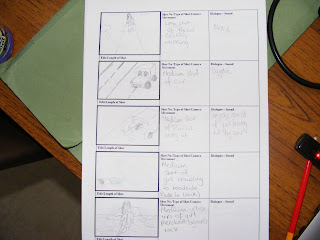
I had to design a storyboard for my short film to get an idea iof the types of shots that I wanted to include in my film and so that I could make ammendments before I actually began to act it out for the filming. I also had to due this after writing my script to make sure that what I had written would look good with the shots and footage I'd later be shooting. Many people do this in the professional industry to get an idea of how their films will look before they begin shooting them.
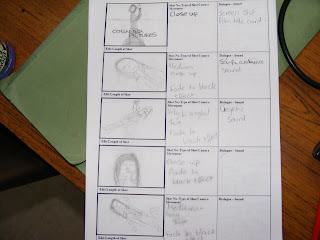
The storyboard starts with the title card which is a picture of the film logo, this is a close-up. There is then a fade to black transition to the first picture of the short film. This picture is a medium-close up of Rachel (the victim. The picture has been edited so that it is black and white. I chose to add this effect at it helps to signal that there is a passage of time and makes the start of the film look effective. Each of the first five photos also have a fade to black transition to make them look dated and old and to create suspense in between each of them being shown. The other three photos have also been edited so that they are black and white. The second photo is of Rachel lying on the ground, it is a medium close up shot. I chose to add a sci-fi ambience piece of non-diegetic music as it makes the scene look more effective and creates suspense as to what will happen next in the film. The third shot is a high angled shot of Rachel which shows how vulnerable she was in the final hours leading up to her death. There is then a fade to black transition again which links to the next photo. The next photo is a close up of Rachel which shows the damage the accident caused to her and crucially signals to the sudience that Rachel is now dead.
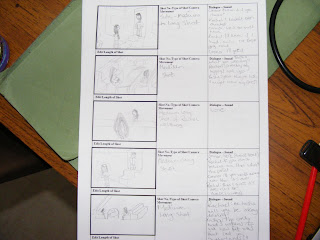
There is a fade to black transition which I put in to contrast the lifelessness Rachel had in the previous scene to the dynamic scenes of her and Connor (her boyfriend) arguing in this scene. This is the first photo which starts the flashbacks of Rachel's life leading up to he death. There is then a cut to a medium shot of Natasha and Rachael Gillis socialising in the pub and talking about their plans for the night ahead. As the girls are in pub, we asked for there to be non-diegetic music in the background. The next scene shows Rachel being so annoyed at Connor that she storms off. This shot is a medium long shot and the camera pans as she walks past Connor's house. A cut is made again to show a medium long shot of Tasha and Rachael talking and Rachael suggesting to Tasha that she has had too much to drink.
The third part of my storyboard begins with a long shot of Rachel walking up a path through the nature park. The next medium shot shows Natasha and Rachael singing in the car. I put non-diegetic music in the background whilst they again talk about how much drink Natasha has had. The crucial shot in the storyboard is a medium shot of Rachel being hit by Natasha driving her car. I chose to add add a slow transition to this scene to make it more effective and emphasise the force Natasha hit Rachel with in the car. There isn't any music in this scene, just diegetic music so that the audience can hear the collison between Rachel's body and the car. A quick cut is made to a medium shot of Rachel crawling away from the hit and run spot and to the safety of the road-side. This shot has had a slow transition added to it so that the audience can see how much the victim is struggling to get to safety. I have also added a fade to black transition to the next part of the scene to show that Rachel has managed to perch herself against a rock close to the radside, but she still remains at harms way.
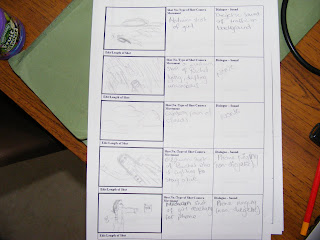
The first shot in this scene is a medium shot of Rachel crawling away from the rock and desperately trying to get to a comfortable place. After this, there is another medium shot of Rachel lying on the grass looking up, desperately attempting to remain concious. I chose to add a point of view shot by Rachel looking up at the sky. This shows that Rachel is loosing conciousness and also shows that she is looking at the sky. There is a medium shot of Racheel lying on the ground while her phone is out of her reach and ringing, as she is unconcious nearly, it shows how much of a struggle she is finding moving to answer it. The music in the background is non-diegetic as you can hear the ringtone from the phone ringing.
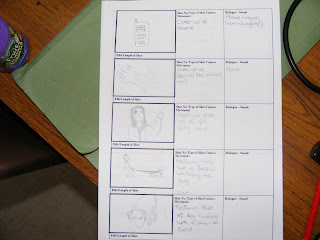
There is a cut to a close-up off the phone then another quick cut to a close-up of Rachel's arm and the blood that is trickling down it. A medium close-up is shown of the girl lying dead now in the middle of nowhere. There is a really quick cut to a long shot of Jordan who is a pedestrain walking his dog in the field that Rachel is lying in. The next scene is a medium shot of the dog running up to Rachel.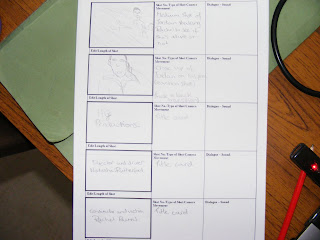
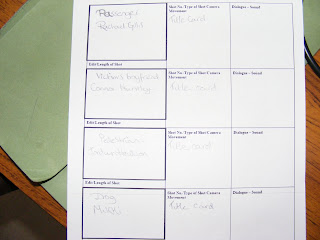
Shortly after this, Jordan is captured in a medium shot shaking Rachel, frantically trying to see if she is alive or not. There is then a fade to black transition which shows the reaction on Jordan's face. The end part of my short film has a fade to black transition on it, which allows the end on the film to roll into te credits.
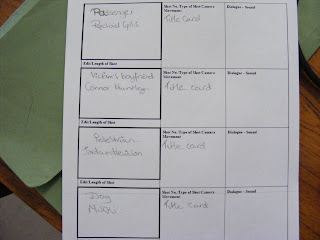
The credits are on a black background and each show the actresses and actors name and there is also a scrren card which shows our film company 'HG Productions'.
These are my front cover and film review designs:

The storyboard starts with the title card which is a picture of the film logo, this is a close-up. There is then a fade to black transition to the first picture of the short film. This picture is a medium-close up of Rachel (the victim. The picture has been edited so that it is black and white. I chose to add this effect at it helps to signal that there is a passage of time and makes the start of the film look effective. Each of the first five photos also have a fade to black transition to make them look dated and old and to create suspense in between each of them being shown. The other three photos have also been edited so that they are black and white. The second photo is of Rachel lying on the ground, it is a medium close up shot. I chose to add a sci-fi ambience piece of non-diegetic music as it makes the scene look more effective and creates suspense as to what will happen next in the film. The third shot is a high angled shot of Rachel which shows how vulnerable she was in the final hours leading up to her death. There is then a fade to black transition again which links to the next photo. The next photo is a close up of Rachel which shows the damage the accident caused to her and crucially signals to the sudience that Rachel is now dead.

There is a fade to black transition which I put in to contrast the lifelessness Rachel had in the previous scene to the dynamic scenes of her and Connor (her boyfriend) arguing in this scene. This is the first photo which starts the flashbacks of Rachel's life leading up to he death. There is then a cut to a medium shot of Natasha and Rachael Gillis socialising in the pub and talking about their plans for the night ahead. As the girls are in pub, we asked for there to be non-diegetic music in the background. The next scene shows Rachel being so annoyed at Connor that she storms off. This shot is a medium long shot and the camera pans as she walks past Connor's house. A cut is made again to show a medium long shot of Tasha and Rachael talking and Rachael suggesting to Tasha that she has had too much to drink.

The third part of my storyboard begins with a long shot of Rachel walking up a path through the nature park. The next medium shot shows Natasha and Rachael singing in the car. I put non-diegetic music in the background whilst they again talk about how much drink Natasha has had. The crucial shot in the storyboard is a medium shot of Rachel being hit by Natasha driving her car. I chose to add add a slow transition to this scene to make it more effective and emphasise the force Natasha hit Rachel with in the car. There isn't any music in this scene, just diegetic music so that the audience can hear the collison between Rachel's body and the car. A quick cut is made to a medium shot of Rachel crawling away from the hit and run spot and to the safety of the road-side. This shot has had a slow transition added to it so that the audience can see how much the victim is struggling to get to safety. I have also added a fade to black transition to the next part of the scene to show that Rachel has managed to perch herself against a rock close to the radside, but she still remains at harms way.

The first shot in this scene is a medium shot of Rachel crawling away from the rock and desperately trying to get to a comfortable place. After this, there is another medium shot of Rachel lying on the grass looking up, desperately attempting to remain concious. I chose to add a point of view shot by Rachel looking up at the sky. This shows that Rachel is loosing conciousness and also shows that she is looking at the sky. There is a medium shot of Racheel lying on the ground while her phone is out of her reach and ringing, as she is unconcious nearly, it shows how much of a struggle she is finding moving to answer it. The music in the background is non-diegetic as you can hear the ringtone from the phone ringing.

There is a cut to a close-up off the phone then another quick cut to a close-up of Rachel's arm and the blood that is trickling down it. A medium close-up is shown of the girl lying dead now in the middle of nowhere. There is a really quick cut to a long shot of Jordan who is a pedestrain walking his dog in the field that Rachel is lying in. The next scene is a medium shot of the dog running up to Rachel.


Shortly after this, Jordan is captured in a medium shot shaking Rachel, frantically trying to see if she is alive or not. There is then a fade to black transition which shows the reaction on Jordan's face. The end part of my short film has a fade to black transition on it, which allows the end on the film to roll into te credits.

The credits are on a black background and each show the actresses and actors name and there is also a scrren card which shows our film company 'HG Productions'.
These are my front cover and film review designs:


Thursday, 5 May 2011
End Product
We finished filming our production but we weren't entirely satisfied with it so we decided to re-film some of the scenes to benefit the rest of our project.
Sunday, 10 April 2011
7th April
We capitalised on the good weather and were able to finish the remainder of our short film. We managed to get the end re-shot so we just have to add the title card to the beginning of the film and add in the credits then we will have a finished project that we are very pleased with.
Monday, 4 April 2011
4th April
We are going to film the boyfriend and girlfriend scene again with Connor and me as the one we currently have, we don't feel is effective enough as it is too short. We are going to take some reaction shots and put them in between the scene as separators so the scene has a more dramatic effect. We are also going to re-shoot part of the hit and run scene as it hasn't quite got the effect we had hoped for so we are going to re-shoot the part where I get hit by the car. By doing the scene from my perspective, we feel it will be more effective as it will show the audience what I was going through as I was ran over.
Friday, 25 March 2011
Filming
We have managed to get almost all of our filming complete to a standard we like in the past few weeks and have even managed to edit most of our film so that it looks more professional. When we had finished editing the scenes we had shot however we realised that we didn't have enough ranges of shots within it, so we are having to re-shoot some early next week and edit them into what we have. Hopefully it will look much better!
Monday, 7 February 2011
3rd February
We attempted to get the end scene of our short film done today but the poor weather conditions didn't allow us to get the scene the way we wanted. We did manage to get a few shootings of the end scene but the hit and run scene that we thought was good failed to meet our expectations as when we were looking back at what we had filmed, we realised there was a cyclist in the background and as he cycled straight past the 'victim'. We thought it would look unrealistic to use this filming as you would expect a passer by to help someone when they are badly injured therefore we have planned to re-shoot this certain part.
Wednesday, 2 February 2011
filming 29.01.11
We started filming the scene where the boyfriend becomes concerned about the well-being of his girlfriend so he decides to ring her. We filmed him looking at the clock part way through the scene so that it showed the struggle his girlfriend had to live before she might die. After uploading these scenes to iMovie however, we realised that the lighting on part of the scene was to dark so we have decided to re-shoot that part as we feel it will benefit our overall filming more than just trying to re-adjust the lighting by the tools available in iMovie.
Monday, 31 January 2011
The Narrative Theory
Propp- Vladimir Propp published his Morphology of Folk-tale in 1928. He studied folk-tales and legends from many different countries and noticed that they tended to be very similar. They seemed to be about the same basic problems and the same basic character types cropped up in most of the folk-tales.
Based on this study, he identified 32 basic categories of action which he called ‘functions’. He also identified a set of basic spheres of action or character functions. He focused on the way characters in folk-tales tended to be types rather than individuals. There are eight of these character types that you should know:
• The hero, who is on the quest (search)
• The villain, who opposes the hero
• The donor, who helps the hero by giving them a magic tool
• The dispatcher, who starts the hero on his way
• The false hero, who attempts the hero away from his quest
• The helper, who helps the hero
• The princess, who is the reward for the hero
• Her father, who rewards the hero for his efforts.
Of course, while there are many texts which do conform to these principles (Star Wars is a very well-known example), you will find at least as many texts which do not seem to do so. You might be able to think of examples where the protagonist (hero) or antagonist (villain) cannot be considered as types in this way (especially in indie or alternative films)- or perhaps a film where the ‘princess’ does not conform to the functions of a princess- Alien might be an example here. But just think of all those Hollywood films where the primary function of the heroine is to be the reward for the hero! The important thing is that you can write about how Propp might or might not be a useful way of deconstructing a text which you are studying. It may be that talking about types will give you a lead into writing about the representational issues, for example, or perhaps considering why Propp’s theories are not appropriate when deconstructing a text will lead you to discuss the ideology of the text in some depth or to think in detail about the audience’s relationship with the text.
Claude Levi-Strauss
Levi-Strauss was a structuralist philosopher. What interested him was how much of our world is described in terms of opposites (or binary oppositions)- night/day, good/bad, light/dark. He noticed that these oppositions tended to structure texts such as stories, plays and films as well. This is easy to think about in terms of typical film but you can also analyse other texts in terms of these binary oppositions:
• Washing powder adverts rely on before and after contrasts to convince you to buy the product.
• News reports tend to be structured as binary opposites because they use the good and bad points to present the story in a simple way.
Rolande Barthes
Barthes was interested in concepts such as negotiated meaning between institution and audience. He argued that the audience that the reader produces new meanings when reading a text, making use of their previous experiences as well as the text itself. So, for example, when watching a docusoap about an airline, individuals’ ‘meaning’ depends as much on their own experiences of airlines and docusoaps as on the text itself. The cultural context of consumption becomes as important as the context of the text. He described texts as ‘networks’, which relates to the current multimedia texts such as websites and the different ways in which a ‘surfer’ interacts with these non-linear texts. The most well known of Barthes’ codes is probably the enigma code. In its most basic form, it is the hook or mystery to be resolved for an audience, e.g. in serials which make use of the old ‘come back next week to find out what happens’ technique, or in trailers for new films.
Todorov
Tzvetan Todorov suggested that there are five stages to a narrative:
• Equilibrium
• A disruption to this equilibrium by an event
• A realisation that a disruption has happened
• An attempt to repair the damage of the disruption
• A restoration of equilibrium-which may be a new equilibrium.
This structure can be applied to fictional and non-fictional texts and can be a good starting point for identifying the structure of a text-just think how many news stories depend on establishing how equilibrium is disrupted. Adverts often use this structure to establish that the product being advertised is the solution to a problem.
Based on this study, he identified 32 basic categories of action which he called ‘functions’. He also identified a set of basic spheres of action or character functions. He focused on the way characters in folk-tales tended to be types rather than individuals. There are eight of these character types that you should know:
• The hero, who is on the quest (search)
• The villain, who opposes the hero
• The donor, who helps the hero by giving them a magic tool
• The dispatcher, who starts the hero on his way
• The false hero, who attempts the hero away from his quest
• The helper, who helps the hero
• The princess, who is the reward for the hero
• Her father, who rewards the hero for his efforts.
Of course, while there are many texts which do conform to these principles (Star Wars is a very well-known example), you will find at least as many texts which do not seem to do so. You might be able to think of examples where the protagonist (hero) or antagonist (villain) cannot be considered as types in this way (especially in indie or alternative films)- or perhaps a film where the ‘princess’ does not conform to the functions of a princess- Alien might be an example here. But just think of all those Hollywood films where the primary function of the heroine is to be the reward for the hero! The important thing is that you can write about how Propp might or might not be a useful way of deconstructing a text which you are studying. It may be that talking about types will give you a lead into writing about the representational issues, for example, or perhaps considering why Propp’s theories are not appropriate when deconstructing a text will lead you to discuss the ideology of the text in some depth or to think in detail about the audience’s relationship with the text.
Claude Levi-Strauss
Levi-Strauss was a structuralist philosopher. What interested him was how much of our world is described in terms of opposites (or binary oppositions)- night/day, good/bad, light/dark. He noticed that these oppositions tended to structure texts such as stories, plays and films as well. This is easy to think about in terms of typical film but you can also analyse other texts in terms of these binary oppositions:
• Washing powder adverts rely on before and after contrasts to convince you to buy the product.
• News reports tend to be structured as binary opposites because they use the good and bad points to present the story in a simple way.
Rolande Barthes
Barthes was interested in concepts such as negotiated meaning between institution and audience. He argued that the audience that the reader produces new meanings when reading a text, making use of their previous experiences as well as the text itself. So, for example, when watching a docusoap about an airline, individuals’ ‘meaning’ depends as much on their own experiences of airlines and docusoaps as on the text itself. The cultural context of consumption becomes as important as the context of the text. He described texts as ‘networks’, which relates to the current multimedia texts such as websites and the different ways in which a ‘surfer’ interacts with these non-linear texts. The most well known of Barthes’ codes is probably the enigma code. In its most basic form, it is the hook or mystery to be resolved for an audience, e.g. in serials which make use of the old ‘come back next week to find out what happens’ technique, or in trailers for new films.
Todorov
Tzvetan Todorov suggested that there are five stages to a narrative:
• Equilibrium
• A disruption to this equilibrium by an event
• A realisation that a disruption has happened
• An attempt to repair the damage of the disruption
• A restoration of equilibrium-which may be a new equilibrium.
This structure can be applied to fictional and non-fictional texts and can be a good starting point for identifying the structure of a text-just think how many news stories depend on establishing how equilibrium is disrupted. Adverts often use this structure to establish that the product being advertised is the solution to a problem.
Friday, 7 January 2011
Filming
On Monday, we decided to film some scenes where the victim was walking through the nature park before she gets hit by the drunken driver. We managed to get the scene filmed the way we wanted and took five or six takes of it to make sure we'd have at least one that we liked and that would benefit our short film.
Monday, 13 December 2010
Filming 13.12.10
Today we decided to film the car scene in our trailer as the weather has improved. Natasha Rutherford played the driver of the car and Rachel Gillis was playing the passenger. They were sitting in the car driving along and talking when Natasha hits a female pedestrian.
The script to this scene is:
Natasha: I feel slightly tipsy
Rachel: well do you really think you should be driving
Natasha: Yeah i'll be okay I only had three vodkas man
Rachel:turn this song up Tasha
Natasha: Aww I love this song
Rachel: I know me too
Natasha: I can't wait for town tonight
This scene happens just before Natasha hits the pedestrian and the victim is dying and having flashbacks of what's happened. There is a variety of shots in the sequence, most of them being close-ups as we filmed from inside the car. There is also a long shot of the car which creates suspense as the registration plate is framed within the shot so the audience are left wondering if the victim has remembered it as she is having flash backs.
The script to this scene is:
Natasha: I feel slightly tipsy
Rachel: well do you really think you should be driving
Natasha: Yeah i'll be okay I only had three vodkas man
Rachel:turn this song up Tasha
Natasha: Aww I love this song
Rachel: I know me too
Natasha: I can't wait for town tonight
This scene happens just before Natasha hits the pedestrian and the victim is dying and having flashbacks of what's happened. There is a variety of shots in the sequence, most of them being close-ups as we filmed from inside the car. There is also a long shot of the car which creates suspense as the registration plate is framed within the shot so the audience are left wondering if the victim has remembered it as she is having flash backs.
Wednesday, 8 December 2010
Wasp Analysis
Wasp Textual Analysis
Wasp is an award winning short film which was directed by Andrea Arnold and stars actors such as Danny Dyer, Natalie Press and Jodie Mitchell. It was hailed by many people as it uses a range of shots and shows the challenges that working class people face in life.
The film shows the struggle a mum is having raising her young children in a rough part of Dartford. At the start of the film, the camera shows a person walking down the stairs which the audience later finds out was the mother. She is viewed walking bare foot down the stairs which would again show that she is working class and the audience is left wondering where she is going without footwear on. There is a high angled shot of the mother looking up at her children from the bottom of the stairs then the camera pans as the children begin to walk down the steps. As the children follow their mother outside, there is a close up shot from behind of the mother carrying the baby without a nappy on. This could show how much the mother is struggling to look after her children as she can’t even afford the bare essentials for them. When the mother arrives at the other mother’s house, there is a long shot of her standing at the door followed by a framed shot of the two of them beginning to fight. Once the fight begins to go onto the grass outside, the camera spins to show how the two mothers’ are being spun around by their hair by each other.
The audience can see straight away that she is a working class mum as her clothing appears cheap. The camera shows an establishing shot of the two mothers fighting and as one of them jumps onto the other and they fall on the floor, the camera goes to their level on the ground and shows on lookers watching them. This could appear a significant shot a it could be suggesting that the two mothers are low for using violence in front of their children. There is a strong use of taboo language which again shows their class to the audience. There is a shot reverse shot of the mother’s reactions to their children’s, then back to the mothers. As the children leave the scene of the fight, they all make a gesture towards the other mother; this allows the audience to see they are greatly influenced by their mother’s actions as she had just previously used taboo language in front of them. There is a medium shot of the mother walking home when there is a car pictured in the back of the scene, giving the audience the impression that they are being followed by someone.
There is a close up of the baby once the mother has handed it over to her eldest daughter to look after while she goes to see her ex boyfriend. Once she is at the car, there is a close medium close up of the ex boyfriend talking to the mother. The fact that he is low down in his car and she is shot appearing higher up than him could signify that she is in a stronger position than him. The shot of the mother looking back to her children whilst they are sitting on the curb side makes them look vulnerable as mother’s wouldn’t usually allow their children to sit near a busy road. There is a shot of the family walking off holding hands which could signal that even though they are struggling, they are united as a family. The shot of the flowers in the field and nothing else, could suggest that the family are isolated in the place that they live.
The audience sees a cut to the different shots of the neighbourhood and how it appears everyone in the neighbourhood is struggling, as the area seems downtrodden. The camera shows a variety of pictures that the children have drew while they were growing up, the non diegetic sound of the baby’s toy in the background combats the showing of the drawings as the mother appears happy while she is looking at them and the music is upbeat. The close up of a sticker that says ‘I want to be Barbie, that bitch has everything’ shows that the mother is very outgoing as people who base themselves on the imagery of Barbie dolls usually receive negative comments and criticism. When the baby starts crying, there is shot of the bag of sugar then a shot back to the baby, allowing the audience to assume that mother is going to feed the baby sugar, and she does just that. There is a long shot of the mother giving the eldest daughter the bag of sugar to share out between her children and ironically saying ‘not too much’ as she can’t afford to fully feed them. A close up of the mother’s purse shows the audience that she has barely any money to support her children. As she is counting her money, there is a non diegetic sound of a wasp buzzing in the background and then a close up of it crawling across the window which allows the audience to make the assumption that it is going to sting someone.
The family all set off to go to the pub and as they are walking, the is a shot of one of the daughters pushing her pram with a doll in it then almost a duplicate shot of the mother pushing the baby. The shot of the two prams is very effective as the doll’s eye closes then opens again making the audience think that it is a voodoo for the baby, therefore something is going to happen to it.
This is a clip from Angela Arnold's Wasp:
Wasp is an award winning short film which was directed by Andrea Arnold and stars actors such as Danny Dyer, Natalie Press and Jodie Mitchell. It was hailed by many people as it uses a range of shots and shows the challenges that working class people face in life.
The film shows the struggle a mum is having raising her young children in a rough part of Dartford. At the start of the film, the camera shows a person walking down the stairs which the audience later finds out was the mother. She is viewed walking bare foot down the stairs which would again show that she is working class and the audience is left wondering where she is going without footwear on. There is a high angled shot of the mother looking up at her children from the bottom of the stairs then the camera pans as the children begin to walk down the steps. As the children follow their mother outside, there is a close up shot from behind of the mother carrying the baby without a nappy on. This could show how much the mother is struggling to look after her children as she can’t even afford the bare essentials for them. When the mother arrives at the other mother’s house, there is a long shot of her standing at the door followed by a framed shot of the two of them beginning to fight. Once the fight begins to go onto the grass outside, the camera spins to show how the two mothers’ are being spun around by their hair by each other.
The audience can see straight away that she is a working class mum as her clothing appears cheap. The camera shows an establishing shot of the two mothers fighting and as one of them jumps onto the other and they fall on the floor, the camera goes to their level on the ground and shows on lookers watching them. This could appear a significant shot a it could be suggesting that the two mothers are low for using violence in front of their children. There is a strong use of taboo language which again shows their class to the audience. There is a shot reverse shot of the mother’s reactions to their children’s, then back to the mothers. As the children leave the scene of the fight, they all make a gesture towards the other mother; this allows the audience to see they are greatly influenced by their mother’s actions as she had just previously used taboo language in front of them. There is a medium shot of the mother walking home when there is a car pictured in the back of the scene, giving the audience the impression that they are being followed by someone.
There is a close up of the baby once the mother has handed it over to her eldest daughter to look after while she goes to see her ex boyfriend. Once she is at the car, there is a close medium close up of the ex boyfriend talking to the mother. The fact that he is low down in his car and she is shot appearing higher up than him could signify that she is in a stronger position than him. The shot of the mother looking back to her children whilst they are sitting on the curb side makes them look vulnerable as mother’s wouldn’t usually allow their children to sit near a busy road. There is a shot of the family walking off holding hands which could signal that even though they are struggling, they are united as a family. The shot of the flowers in the field and nothing else, could suggest that the family are isolated in the place that they live.
The audience sees a cut to the different shots of the neighbourhood and how it appears everyone in the neighbourhood is struggling, as the area seems downtrodden. The camera shows a variety of pictures that the children have drew while they were growing up, the non diegetic sound of the baby’s toy in the background combats the showing of the drawings as the mother appears happy while she is looking at them and the music is upbeat. The close up of a sticker that says ‘I want to be Barbie, that bitch has everything’ shows that the mother is very outgoing as people who base themselves on the imagery of Barbie dolls usually receive negative comments and criticism. When the baby starts crying, there is shot of the bag of sugar then a shot back to the baby, allowing the audience to assume that mother is going to feed the baby sugar, and she does just that. There is a long shot of the mother giving the eldest daughter the bag of sugar to share out between her children and ironically saying ‘not too much’ as she can’t afford to fully feed them. A close up of the mother’s purse shows the audience that she has barely any money to support her children. As she is counting her money, there is a non diegetic sound of a wasp buzzing in the background and then a close up of it crawling across the window which allows the audience to make the assumption that it is going to sting someone.
The family all set off to go to the pub and as they are walking, the is a shot of one of the daughters pushing her pram with a doll in it then almost a duplicate shot of the mother pushing the baby. The shot of the two prams is very effective as the doll’s eye closes then opens again making the audience think that it is a voodoo for the baby, therefore something is going to happen to it.
This is a clip from Angela Arnold's Wasp:
Wednesday, 1 December 2010
Different Camera shots
As I was making a short film, I decided to look into the different types of shots you can get in a film.
This is a close up shot: This shot can be used in horror trailers to create suspense or give away short parts of the film like the face of who the killer could be.
An extreme close up shot of something gives the audience a teaser as it can give hints as to who the killer in a film could be due to a shot of their eyes.
A high angle shot can show the vulnerability of someone and give a birdseye view of something
A low angle camera shot can show characters on different levels, for example a character who appears taller than the other could have a stronger personality and a character on a lower level could be weaker.
This is a close up shot:
 This shot can be used in horror trailers to create suspense or give away short parts of the film like the face of who the killer could be.
An extreme close up shot of something gives the audience a teaser as it can give hints as to who the killer in a film could be due to a shot of their eyes.

A high angle shot can show the vulnerability of someone and give a birdseye view of something

A low angle camera shot can show characters on different levels, for example a character who appears taller than the other could have a stronger personality and a character on a lower level could be weaker.

Monday, 22 November 2010
Locations
After considering our options, Natasha Rutherford and I have decided to split from the rest of the group and do a short film. We have decided to do this as we think we will benefit more from doing this.
The story:
The story is about a young woman who has a row with her boyfriend so she storms off, as she is walking home, she gets hit by a car and is left in a life or death situation because the drunk driver leaves her as she is scared of losing her license. The film shows the girl fighting for her life at the road side recollecting how she has been left in this situation and how she desperately trying to get help. The scenes that go backwards show the driver drinking in a local pub then she gets into her car with her friend. They are driving when the driver hits the girl. The driver’s friend tells her to get out of the car and help the victim but she doesn’t want to as she thinks she’ll lose her license and that the victim won’t survive. Her friend fails to convince the driver that the victim is seriously hurt, so they drive on leaving the injured person to fight for their life.
Locations:
We have decided to keep the locations to our film local as we feel there are many places within our area that will benefit our short film. The locations we have decided to include in our film are: The Sutherlands pub, the Windy Nook Nature Park, a house, a roadside and a car.
Filming:
We decided to start filming part of our trailer, the part we chose to film first was when the girl and her boyfriend split up and she walks off. Unfortunately, due to the weather, we have been unable to film this anymore scenes this week so we will have to presume filming as soon as possible.
The story:
The story is about a young woman who has a row with her boyfriend so she storms off, as she is walking home, she gets hit by a car and is left in a life or death situation because the drunk driver leaves her as she is scared of losing her license. The film shows the girl fighting for her life at the road side recollecting how she has been left in this situation and how she desperately trying to get help. The scenes that go backwards show the driver drinking in a local pub then she gets into her car with her friend. They are driving when the driver hits the girl. The driver’s friend tells her to get out of the car and help the victim but she doesn’t want to as she thinks she’ll lose her license and that the victim won’t survive. Her friend fails to convince the driver that the victim is seriously hurt, so they drive on leaving the injured person to fight for their life.
Locations:
We have decided to keep the locations to our film local as we feel there are many places within our area that will benefit our short film. The locations we have decided to include in our film are: The Sutherlands pub, the Windy Nook Nature Park, a house, a roadside and a car.
Filming:
We decided to start filming part of our trailer, the part we chose to film first was when the girl and her boyfriend split up and she walks off. Unfortunately, due to the weather, we have been unable to film this anymore scenes this week so we will have to presume filming as soon as possible.
Wednesday, 20 October 2010
The making of music videos
A music video is a short film or video that accompanies a piece of music. Modern music videos are primarily made and used as a marketing device intended to promote the sale of music recordings. Although the origins of music videos date back much further, they came into prominence in the 1980s, when MTV based their format around the medium. Prior to the 80s, these works were described by various terms including "illustrated song", "filmed insert", "promotional (promo) film", "promotional clip" or "film clip". In Chinese entertainment, music videos were simply known as "MTVs" because the network was responsible for bringing music videos to popularity in that country.
Music videos use a wide range of styles of film making techniques, including animation, live action filming, documentaries, and non-narrative approaches such as abstract film. Some music videos blend different styles, such as animation and live action. Many music videos do not interpret images from the song's lyrics, making it less literal than expected.If you're a film maker making a music video is a good way of getting exposure and experience and bands are often happy to give you a creative free reign. A video doesn't need to cost a fortune what's important is having a good idea and working within your budget. Production companies charge a fortune for even the simplest promo video, but you can easily do it yourself. First things first, however. You have to choose your song.
While it might make sense to make a video for your upcoming single there are a few other factors to consider:
It can take a lot longer than you think to make a video, so by the time it's finished your single might have come out. It might be an idea to think about making the video for a subsequent single. Having said that, in these days of internet downloads, any track can be seen as a single, so there might be a track on the album that you have a great idea for a video for, even if that track wasn't originally planned as a single. Remember that it can take a long time to shoot and edit each second of video so while you might have a good idea for a video for that 10 min epic that closes the album it might be more practical to shoot a video for the 3 min pop song. However complicated (or simple) your shoot is, you'll need a team of people. As well as the actors/performers you'll need:
Camera person – At least one, and maybe more.
Lighting Person – If you're filming inside you'll need lighting, and someone to look after it.
Director/dogsbody – You need someone in charge of the shoot, making sure everything is running smoothly, and who can go buy batteries when you need them.
Music videos use a wide range of styles of film making techniques, including animation, live action filming, documentaries, and non-narrative approaches such as abstract film. Some music videos blend different styles, such as animation and live action. Many music videos do not interpret images from the song's lyrics, making it less literal than expected.If you're a film maker making a music video is a good way of getting exposure and experience and bands are often happy to give you a creative free reign. A video doesn't need to cost a fortune what's important is having a good idea and working within your budget. Production companies charge a fortune for even the simplest promo video, but you can easily do it yourself. First things first, however. You have to choose your song.
While it might make sense to make a video for your upcoming single there are a few other factors to consider:
It can take a lot longer than you think to make a video, so by the time it's finished your single might have come out. It might be an idea to think about making the video for a subsequent single. Having said that, in these days of internet downloads, any track can be seen as a single, so there might be a track on the album that you have a great idea for a video for, even if that track wasn't originally planned as a single. Remember that it can take a long time to shoot and edit each second of video so while you might have a good idea for a video for that 10 min epic that closes the album it might be more practical to shoot a video for the 3 min pop song. However complicated (or simple) your shoot is, you'll need a team of people. As well as the actors/performers you'll need:
Camera person – At least one, and maybe more.
Lighting Person – If you're filming inside you'll need lighting, and someone to look after it.
Director/dogsbody – You need someone in charge of the shoot, making sure everything is running smoothly, and who can go buy batteries when you need them.
Locations we could be using in our music video
On the 10th of October we went to Newcastle to take pictures of locations around the area.
This is a photo of The Gate. We all agreed this would be a really good location to film the party or romantic parts in our music video.

Other photos we took were of a cafe:

A picture of treeland area:

A picture of a part of Newcastle that contains graffiti:

To get an idea of the types of shots I need to include within my music video I analysed the different types of shots there are.

This shoy is a high angled shot and it could show vulnerability and create a new dimension to the video.
This is a photo of The Gate. We all agreed this would be a really good location to film the party or romantic parts in our music video.

Other photos we took were of a cafe:

A picture of treeland area:

A picture of a part of Newcastle that contains graffiti:

To get an idea of the types of shots I need to include within my music video I analysed the different types of shots there are.

This shoy is a high angled shot and it could show vulnerability and create a new dimension to the video.
Analysis of Music Videos
Analysis:
Music video analysis of the number of shots and locations included in certain videos.
Cheryl Cole-Promise: http://www.muzu.tv/cherylcole/promise-this-music-video/766413?country=gb
After analysing this video I found that there were 158 shots in her 3 minutes and 36 seconds video, they were all at a variety of heights, positions, angles and speeds. There were also a number of transitions within the video. with one of my responsibilities in the group being the location setter, I took note of the muber of them in a variety of videos. This particular Cheryl Cole one had locations in: a room, on a balcony, in the woodlands outside and on the ground outside. This particular video had a lot of close up of the artist as the record company see her as a big demand. The lyrics also complement the video.
The second video I analysed was Labrinth-Let The Sun Shine
http://www.muzu.tv/labrinth/let-the-sunshine-music-video/771638?country=gb. In this video the locations were: in an arcade scene, ouside in the rain, indoors with spotlights on the singer, the singer dancing infront of a striped background, indoors with speakers behind the singer, in a basement, outside with a graphically moving background. This particular video had 7 different locations each matching and complementing the song.This particular video has its own music style and iconography.
The next video I analysed for locations was Taio Cruz-Dynamite
http://www.muzu.tv/taiocruz/dynamite-music-video/709500?country=gb
In this video the locations were: An area outside near a garage, in the back of a limosine and in a room with little lighting.
I also analysed The Script's video which is called For The First Time.
http://www.muzu.tv/thescript/for-the-first-time-music-video/727627?country=gb
The locations in this video were: in a house, in the streets of New York, in an area with trees, on the riverbanks of New York, in a darkened room with the artist playing.
Another video I analysed for locations was Roll Deep-Green Light
http://www.muzu.tv/rolldeep/green-light-music-video/710267?country=gb
The locations within this video were: in the streets, in a room with the artist in a car and the dancers around him, in a room with a tiled background that has traffic lights in it complementing the song.
All these videos provided my group and me with ideas of locations that were local and easy to access for filming our music video.
Music video analysis of the number of shots and locations included in certain videos.
Cheryl Cole-Promise: http://www.muzu.tv/cherylcole/promise-this-music-video/766413?country=gb
After analysing this video I found that there were 158 shots in her 3 minutes and 36 seconds video, they were all at a variety of heights, positions, angles and speeds. There were also a number of transitions within the video. with one of my responsibilities in the group being the location setter, I took note of the muber of them in a variety of videos. This particular Cheryl Cole one had locations in: a room, on a balcony, in the woodlands outside and on the ground outside. This particular video had a lot of close up of the artist as the record company see her as a big demand. The lyrics also complement the video.
The second video I analysed was Labrinth-Let The Sun Shine
http://www.muzu.tv/labrinth/let-the-sunshine-music-video/771638?country=gb. In this video the locations were: in an arcade scene, ouside in the rain, indoors with spotlights on the singer, the singer dancing infront of a striped background, indoors with speakers behind the singer, in a basement, outside with a graphically moving background. This particular video had 7 different locations each matching and complementing the song.This particular video has its own music style and iconography.
The next video I analysed for locations was Taio Cruz-Dynamite
http://www.muzu.tv/taiocruz/dynamite-music-video/709500?country=gb
In this video the locations were: An area outside near a garage, in the back of a limosine and in a room with little lighting.
I also analysed The Script's video which is called For The First Time.
http://www.muzu.tv/thescript/for-the-first-time-music-video/727627?country=gb
The locations in this video were: in a house, in the streets of New York, in an area with trees, on the riverbanks of New York, in a darkened room with the artist playing.
Another video I analysed for locations was Roll Deep-Green Light
http://www.muzu.tv/rolldeep/green-light-music-video/710267?country=gb
The locations within this video were: in the streets, in a room with the artist in a car and the dancers around him, in a room with a tiled background that has traffic lights in it complementing the song.
All these videos provided my group and me with ideas of locations that were local and easy to access for filming our music video.
Subscribe to:
Posts (Atom)